
use AI tools to discover brands
buy from AI-recommended brands
2026 have zero-click outcomes
mentions come from third-party sites
Introduction
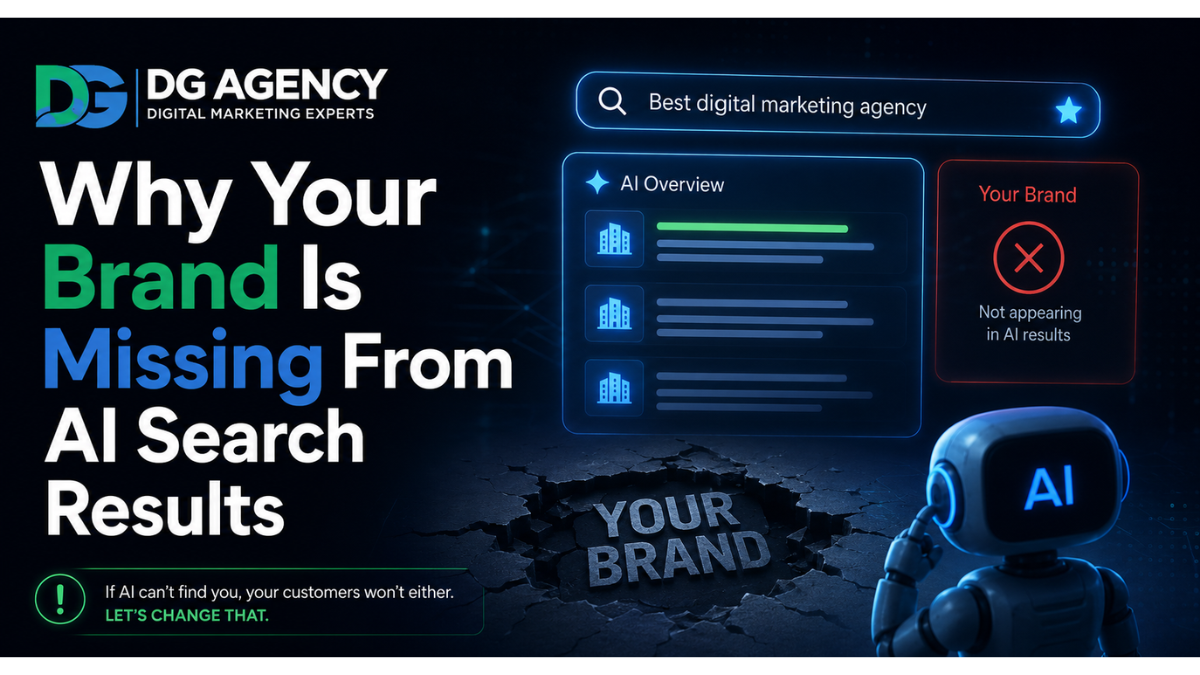
Picture this. You open ChatGPT and type: ‘What are the best digital marketing agencies in India?’ Or you ask Perplexity: ‘Which software tools are best for small business accounting?’ Your competitor shows up. You do not. This is not just bad luck. There is a real reason why your brand is missing from AI search results — and the good news is that every single reason is fixable.
In 2026, AI-powered tools like ChatGPT, Google Gemini, Perplexity, and Claude are not just search engines. They are recommendation engines. When someone asks them a question, they pick a few trusted brands and name them. If your brand is not one of them, you lose a customer — without even knowing it.
This guide explains why your brand may be invisible to AI search tools, what signals AI models use to decide who to recommend, and the exact steps you can take right now to show up. We will use simple language throughout because this topic does not need to be complicated.
What Is AI Search Visibility?
What Does AI Search Visibility Actually Mean?
AI search visibility means how often, and how accurately, your brand appears in AI-generated answers. When someone types a question into ChatGPT or Gemini, the AI does not just list websites. It reads through lots of online content, decides which brands are trustworthy and relevant, and then writes an answer — mentioning those brands by name.
Traditional SEO helped you rank on page one of Google. AI visibility means being the brand the AI chooses to recommend. These are very different goals, and they need different strategies.
This new practice is called Generative Engine Optimization (GEO) or Answer Engine Optimization (AEO). It is the process of making your brand easy for AI models to understand, trust, and recommend.
Why This Matters More Than Ever in 2026
According to Gartner, AI-driven searches are expected to account for 25% of all search queries by 2026. Google itself has rolled out AI Overviews — AI-written summaries at the very top of search results — which now appear for millions of queries every day. Perplexity has grown to over 100 million monthly users. People are changing how they search, and brands that are not visible in AI answers will simply be left behind.
If you are not showing up in AI answers today, you are already losing potential customers to brands that understood this shift earlier.
How AI Search Decides Which Brands to Show
CRAWLABILITY — AI bots can find & read your content
CONTENT QUALITY — Clear, deep, expert-level writing
TOPICAL AUTHORITY — You cover topics end-to-end
THIRD-PARTY TRUST — Reviews, citations, PR mentions
ENTITY RECOGNITION — AI ‘knows’ your brand clearly
6 Real Reasons Your Brand Is Missing From AI Search Results
1. AI Crawlers Cannot Read Your Website
Most website owners do not know this, but AI search tools use their own crawlers — programs that scan the web to collect information. Tools like GPTBot (OpenAI), PerplexityBot, and Google’s crawlers visit your website and read your content. If these bots are blocked by your robots.txt file, your website is completely invisible to those AI tools.
2. Your Content Is Thin, Generic, or Unclear
AI models pull from content that is detailed, specific, and genuinely useful. If your homepage says something vague like ‘We deliver innovative solutions for modern businesses,’ the AI has no idea what you actually do. It cannot confidently recommend you because it cannot clearly explain who you are.
3. Other Websites Never Mention Your Brand
Here is a truth that surprises many business owners: AI models care more about what other people say about you than what you say about yourself. If your brand only appears on your own website, the AI treats you as unproven. Third-party mentions — in news articles, blog posts, review sites like G2 or Trustpilot, industry forums, and social media — are what build your credibility in the AI’s ‘mind’.
4. You Have No Topical Authority
Topical authority means you are known as a deep expert on a specific subject. AI models are trained to recognize brands that consistently publish high-quality content around a core topic. If your blog jumps between unrelated subjects, or if your content is outdated, the AI sees you as a generalist with no clear expertise.
5. Your Brand Is Not a Recognized Entity
AI models build what is called a ‘knowledge graph’ — a map of entities (brands, people, products) and how they connect. If your brand does not have a strong entity footprint — no Wikipedia or Wikidata entry, no Google Knowledge Panel, no consistent information across the web — the AI is not sure you are real or relevant.
6. Your Content Is Not Structured for AI Answers
AI models love content that is easy to extract and summarize. If your blog posts are long walls of unbroken text with no clear structure, the AI finds it hard to pull out a useful answer. Conversely, content with clear headings, bullet points, numbered lists, FAQ sections, and direct question-and-answer formats gets cited far more often.
How to Diagnose Your AI Visibility
How to Check If Your Brand Is Missing From AI Search
Before you start fixing things, you need to understand exactly where you stand. Here is a simple 3-step test you can do right now, for free.
Open ChatGPT, Gemini, and Perplexity. In each one, type: ‘What are the best [type of business] companies for [your service or product]?’ See if your brand appears. If your competitors show up and you do not, you have a clear AI visibility gap.
On the same platforms, ask: ‘What do you know about [your brand name]?’ Read the response carefully. Is it accurate? Is it current? Is it positive? If the answer is vague, wrong, or outdated, the AI has very little quality information about you — and that is a serious problem to fix.
Compare your results across at least two or three AI platforms. If you show up on one but not others, you have a multi-platform fragmentation issue. Different AI tools use different data sources, so you need a consistent presence across the open web.
Run these three tests and note down your results. They will tell you which of the six problems above is hurting you most — and where to focus first.
Your Step-by-Step GEO Action Plan for 2026
Generative Engine Optimization (GEO) is not a one-time fix. It is an ongoing strategy that builds your brand’s credibility with AI tools over time. Here is what a solid GEO plan looks like.
Month 1 — Fix the Technical Foundations
- Audit your robots.txt file and allow all major AI crawlers.
- Update your XML sitemap and submit it to Google Search Console.
- Add schema markup (Organization, FAQ, HowTo, Article types) to key pages.
- Set up consistent NAP (Name, Address, Phone) data across all directories.
- Claim your Google Business Profile and fill every section completely.
Month 2 — Build Topical Authority With Better Content
- Choose 3-5 core topics your brand genuinely knows well.
- Write one long, comprehensive ‘pillar guide’ for each core topic (2,000+ words).
- Write 4-6 supporting articles for each pillar covering related sub-topics.
- Add FAQ sections to every major page — use real questions your customers ask.
- Update any blog posts older than 18 months with fresh data and examples.
Month 3 — Build External Authority and Brand Mentions
- Use HARO (Help a Reporter Out) to get quoted in news articles.
- Reach out to industry blogs and offer to write guest posts.
- Encourage genuine customer reviews on G2, Trustpilot, or Google Reviews.
- Create useful content on LinkedIn, Reddit, and Quora — AI tools cite these heavily.
- Issue press releases for company milestones, product launches, and research.
Ongoing — Track, Measure, and Improve
- Run the 3-step AI visibility check every month.
- Track your brand mentions using tools like Mention, Brand24, or Semrush.
- Monitor your Google AI Overview appearances in Google Search Console.
- Keep publishing: aim for 2-4 new quality articles per month.
- Build citation authority — it compounds over time, just like domain authority.
GEO vs Traditional SEO: What Is Different?
Many business owners ask: ‘If I am already doing SEO, do I also need GEO?’ The honest answer is yes — because the goals, signals, and measurements are genuinely different. Here is a clear comparison:
| Factor | Traditional SEO | GEO / AI Visibility |
|---|---|---|
| Goal | Rank on page 1 of Google | Get cited in AI answers |
| Success Metric | Search ranking, organic traffic | Brand mentions, AI citations |
| Key Signal | Backlinks, keywords | Entity authority, topical depth |
| Content Style | Keyword-optimised pages | Direct answers, FAQ, structured data |
| Where It Appears | Google SERPs | ChatGPT, Gemini, Perplexity, AI Overviews |
| Update Frequency | Quarterly updates fine | Frequent updates needed |
| Third-Party Signals | Domain authority matters | External brand mentions critical |
The smart approach in 2026 is to do both. Fix your technical SEO so Google can find you, then layer GEO strategies on top so AI tools can understand and recommend you. The two strategies support each other — good content that earns links and trust works for both Google and for AI models.
A Real-World Example: From Invisible to AI-Recommended
Consider a mid-sized HR software company. They had good SEO rankings but were nowhere to be seen on ChatGPT or Perplexity. After running the 3-step AI visibility check, they found three problems:
The Problems They Found
- GPTBot was blocked in their robots.txt file.
- Their blog had 60+ articles but no clear topical focus — the content scattered across HR, payroll, culture, and general business topics.
- They had almost no third-party mentions outside their own website.
What They Did
- Unblocked AI crawlers immediately — a five-minute fix.
- Chose ‘HR software for small teams’ as their core topical niche.
- Wrote three comprehensive pillar guides covering onboarding, leave management, and performance reviews.
- Started a HARO campaign and secured mentions in 4 HR industry publications within 60 days.
- Added structured data (FAQ schema) to all major product pages.
Frequently Asked Questions About AI Search Visibility
It depends on your starting point. Technical fixes like unblocking crawlers can take effect within a few weeks. Building topical authority and earning third-party mentions typically takes 3-6 months of consistent effort.
Not necessarily. Wikipedia helps, but it is not the only path. Strong third-party mentions, a Google Knowledge Panel, and consistent structured data across the web can achieve similar results for most brands.
No. GEO and SEO work together. Strong SEO helps your pages get indexed and trusted, which in turn helps your GEO. The difference is that GEO adds new goals — being cited in AI answers — on top of traditional ranking goals.
Start with the platforms your customers use most. For most B2B companies, ChatGPT and Perplexity are the priority. For consumer brands, Google Gemini (which powers AI Overviews) is especially important.
Yes — and sometimes better. AI tools value deep expertise over broad reach. A small business that is the clearest, most authoritative voice on a narrow niche topic can outrank much larger brands in AI-generated answers.
Final Thoughts: The Window Is Open — Act Now
AI search is not the future. It is right now. Every day that your brand is missing from AI-generated answers is a day your competitors are being chosen instead. The brands that are building their AI visibility today will be the ones that AI models cite in 2027, 2028, and beyond.
The good news is that most brands in most industries have not started yet. This means the window is still open. You can get ahead simply by starting today — fixing your crawlability, building topical authority, earning third-party mentions, and structuring your content for AI.
Start with the 3-step AI visibility check above. Find out exactly where your brand stands. Then pick the single biggest gap and fix it first. Small, consistent steps — done every month — will build a compounding advantage that is very hard for competitors to copy.
Is Your Brand Invisible to AI?
Get a FREE AI Visibility Audit and find out why ChatGPT, Gemini & Perplexity are not recommending your brand — and exactly how to fix it.
Claim Your Free AI Visibility Audit Now